Legal and Tax Compliance for Different Industries in Nepal 2025
Learn the legal and tax compliance for all the industries of Nepal.
By Nishan Khadka·Taxation·7 months ago·8 min read
Introduction
Nepal's economy is steadily diversifying, with industries ranging from agriculture to information technology playing crucial roles in its development. However, one of the biggest challenges businesses face is staying compliant with the legal and tax frameworks that govern their operations.
Whether you are running a small hotel in Pokhara, a manufacturing unit in Biratnagar, an IT startup in Kathmandu, or a bank regulated by Nepal Rastra Bank (NRB), understanding compliance requirements is essential. Non-compliance not only brings financial penalties and legal disputes but can also harm a company's reputation and long-term sustainability.
Over the past decade, Nepal has strengthened its taxation system, improved labor laws, and introduced digital compliance platforms under the Inland Revenue Department (IRD). Similarly, industry-specific bodies like the Department of Tourism, Department of Industry, and Ministry of Agriculture have made compliance checks more rigorous.
This blog explores in detail the legal and tax compliance requirements for different industries in Nepal—manufacturing, tourism and hospitality, IT and technology, agriculture, and banking and finance along with best practices to stay compliant.
Overview of Legal and Tax Compliance in Nepal
Compliance in Nepal involves following company registration laws, tax obligations, labor regulations, and industry-specific rules. While the general framework applies to all businesses, industries have additional sector-specific requirements.
Key Government Authorities and Regulatory Bodies
Office of Company Registrar (OCR): Oversees company registration, renewal, mergers, and liquidation.
Inland Revenue Department (IRD) : Manages income tax, VAT, excise duty, and withholding taxes.
Nepal Rastra Bank (NRB): Regulates financial institutions and approves foreign direct investments (FDI).
Department of Industry (DOI): Handles industry licensing, foreign investment approvals, and industrial incentives.
Department of Tourism and Nepal Tourism Board: Manage tourism-related businesses.
Ministry of Agriculture and Food Technology and Quality Control: Regulates agriculture, food safety, and agri-based industries.
Common Types of Taxes in Nepal
Corporate Income Tax: Charged at different rates depending on industry. For most businesses, it is 25%.
Value Added Tax (VAT): Levied at 13% on most goods and services.
Excise Duty: Imposed on industries such as tobacco, alcohol, and petroleum.
Customs Duty: Applied on imports and exports.
Withholding Tax: Deducted at source on payments like rent, salaries, and dividends.
Challenges in Compliance
Frequent policy changes
Complex documentation requirements
Limited awareness of digital systems
High cost of compliance for SMEs
Legal and Tax Compliance for the Manufacturing Industry in Nepal
Manufacturing is one of Nepal's oldest and most regulated sectors. Compliance requirements are stringent because of its role in employment, revenue generation, and environmental impact.
Company Registration and Licensing
Manufacturers must:
Register their company with the OCR.
Obtain an industry license from the Department of Industry if capital investment exceeds NPR 100 million.
Acquire municipal business licenses.
Secure environmental approvals (EIA or IEE) depending on factory size.
Tax Compliance
VAT: Mandatory for turnover above NPR 5 million per year. VAT must be collected from customers and remitted monthly.
Excise Duty: Applicable for goods like liquor, tobacco, cement, and petroleum.
Income Tax: 25% corporate tax, with possible concessions for certain industries.
Labor Law Requirements
Compliance with the Labour Act 2017, which mandates:
Employment contracts in writing
Payment of minimum wages (revised every 2 years)
Contribution to Social Security Fund (SSF)
Worker safety and occupational health standards
Environmental Compliance
Factories must follow:
Environmental Protection Act (EPA) provisions
Waste management standards
Emission and noise pollution guidelines
Example
In 2022, a beverage factory in Chitwan faced penalties for failing to register under VAT despite exceeding the turnover threshold. This case highlighted the importance of early registration and accurate reporting.
Legal and Tax Compliance for the Tourism and Hospitality Industry in Nepal
Tourism contributes nearly 7% of Nepal's GDP and is among the most regulated industries.
Licensing and Registration
Hotels must obtain licenses from the Department of Tourism.
Travel agencies and trekking operators must be registered with the Tourism Board.
Restaurants and bars need permits from local municipalities.
Tax Obligations
Corporate Income Tax: Standard 25%.
Service Charges: Legally mandated 10% service charge must be distributed among staff.
VAT: Applied on accommodation, tour packages, and restaurant bills.
Labor Compliance
Hotels and restaurants must follow labor laws, especially on working hours and seasonal staff contracts.
Occupational safety rules apply to adventure tourism providers.
Local Taxes
Municipalities impose business tax, signboard fees, and tourism promotion charges.
Example
A hotel in Kathmandu was fined in 2021 for failing to distribute service charges to employees, a clear violation of labor compliance rules.
Legal and Tax Compliance for the IT and Technology Sector in Nepal
Nepal's IT industry has grown rapidly, especially in outsourcing and software exports. Compliance requirements are unique compared to traditional industries.
Company Incorporation and IP Rights
IT companies must be registered under OCR.
Copyrights and trademarks protect software, designs, and digital products.
Taxation Rules
VAT: Applied on IT services provided within Nepal.
Export Rebates: Export earnings may be exempt from VAT and eligible for corporate income tax rebates.
TDS (Tax Deducted at Source): Applied to freelancer and outsourcing payments.
Foreign Direct Investment (FDI)
FDI requires approval from the Department of Industry and clearance from NRB.
IT startups must submit detailed project reports for approval.
Cybersecurity and Data Laws
Governed by the Electronic Transactions Act 2008.
Businesses must ensure data privacy and cybersecurity measures.
Example
In 2023, several Nepali outsourcing firms faced compliance checks for underreporting earnings to avoid VAT. The IRD has since tightened digital reporting requirements.
Legal and Tax Compliance for the Agriculture and Agro-Based Industry in Nepal
Agriculture employs over 60% of Nepal's workforce and enjoys several compliance exemptions.
Licensing and Registration
Agri-based businesses must register with OCR and the Department of Agriculture.
Food processing requires permits under the Nepal Food Act 1967.
Tax Incentives
Income tax exemptions for farmers and small agribusinesses.
Subsidies on fertilizers, machinery, and exports.
Exemption from VAT for primary agricultural products.
Food Safety Compliance
Businesses must comply with hygiene, labeling, and quality standards.
Inspections by Food Technology and Quality Control authorities are routine.
Export and Import Rules
Customs duties are relaxed for agri-exports.
Quarantine checks are required for plant and animal products.
Example
A dairy cooperative in Lalitpur faced suspension in 2020 after failing quality checks under the Food Act, highlighting the importance of food safety compliance.
Legal and Tax Compliance for the Banking and Financial Services Sector in Nepal
The financial sector is the most tightly regulated in Nepal.
Licensing and Approvals
Banks, finance companies, and cooperatives must obtain licenses from NRB.
Capital requirements are set by NRB and revised regularly.
Taxation Rules
Corporate Income Tax: 30% for banks (higher than other sectors).
Withholding Tax: Deducted on interest and dividends.
VAT: Certain banking services are VAT-exempt, but others (like locker rentals) are taxable.
AML and KYC Compliance
Strict Anti-Money Laundering (AML) rules apply.
Banks must follow Know Your Customer (KYC) norms for every account.
Corporate Governance
Mandatory yearly audits.
Submission of prudential reports to NRB.
Strict internal governance under NRB directives.
Example
In 2021, a finance company was fined for failing to report suspicious transactions under AML laws, signaling tighter regulatory enforcement.
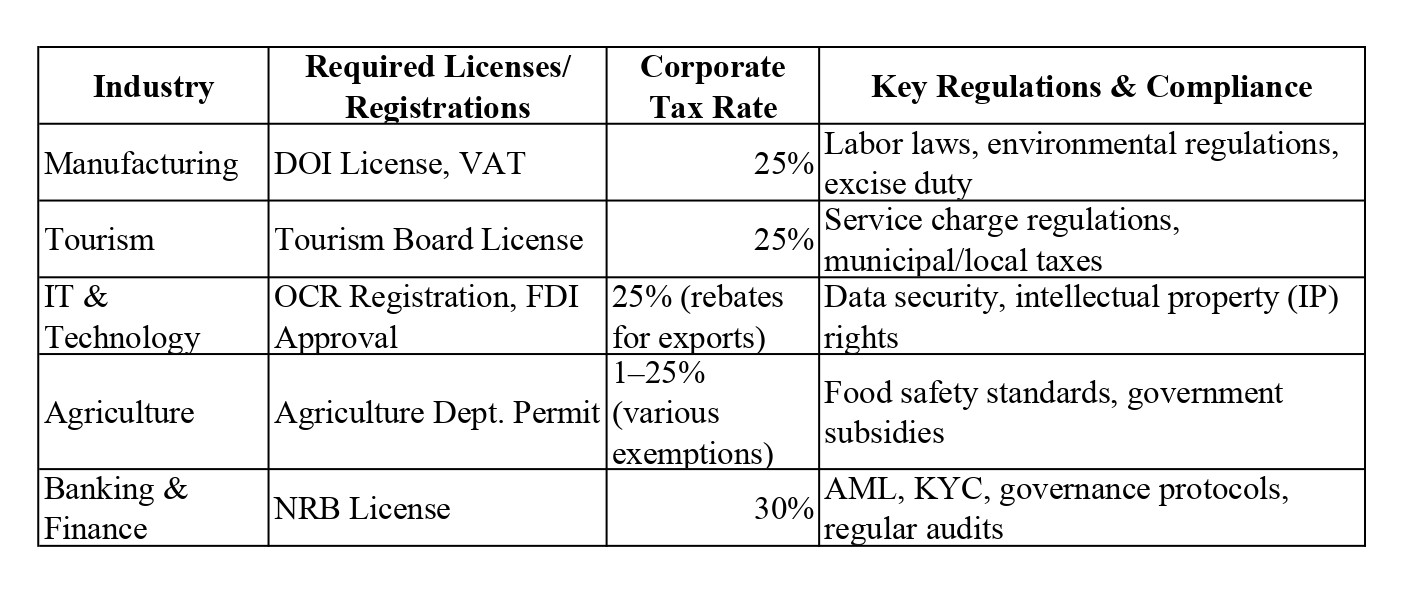
Industry-Wise Comparison of Compliance Requirements
Hire Legal and Tax Consultants: Experts help avoid costly mistakes.
Digital Record-Keeping: Use accounting and HR software for transparency.
Regular Audits: Internal and external audits help detect issues early.
Stay Updated: Follow IRD, NRB, and DOI notices regularly.
Training Employees: Ensure staff understand compliance responsibilities.
Frequently Asked Questions (FAQs)
1. What is the penalty for not registering VAT in Nepal? Businesses exceeding the VAT threshold must register. Failure leads to heavy fines and possible closure.
2. Can foreign investors own 100% of a Nepali IT company? Yes, with prior approval from the Department of Industry and NRB.
3. How often should business licenses be renewed? Most municipal and industry licenses must be renewed annually.
4. Are agriculture businesses exempt from all taxes? No. Farmers enjoy exemptions, but agri-processing companies still face income tax and VAT depending on scale.
5. Is compliance more difficult for SMEs than large corporations? Yes, because SMEs lack compliance staff, but simplified digital systems are being introduced.
Final Thoughts
Compliance is no longer optional—it is the foundation of sustainable business in Nepal. While the process can be complex, proper planning, documentation, and expert guidance make it manageable.
Each industry whether manufacturing, tourism, IT, agriculture, or banking has unique rules, but the principles remain the same: transparency, accountability, and responsibility.
By adopting best practices, using digital systems, and staying updated with regulatory changes, businesses can not only avoid penalties but also build trust with investors, customers, and regulators.
If you’re an entrepreneur having issues in legal and tax compliances for your business or need guidance at any step, Estartup Nepal is here to help. From registering business to business consulting, we make the process simple, stress-free, and fully compliant. Have questions or facing any issues? Feel free to reach out—our team is always ready to support you.