Nepal's telecommunications sector is one of the country's most important industries, connecting millions of people through mobile, internet, and digital communication services. At present, the market is dominated by two major operators: Nepal Telecom (NTC) and Ncell, creating a telecom duopoly that serves virtually the entire mobile subscriber base of Nepal.
With increasing demand for high-speed internet, digital services, and the anticipated rollout of 5G technology, many investors are interested in understanding how telecom businesses are regulated and whether new entrants can enter the market.
This guide explains the telecom industry in Nepal, compares NTC and Ncell, and provides a detailed overview of the telecom company registration process, licensing requirements, and security deposit obligations.
Overview of Nepal's Telecom Industry
Nepal's telecommunications sector is regulated by the Nepal Telecommunications Authority (NTA), established under the Telecommunications Act, 2053 (1997).
The industry consists of:
Mobile network operators
Internet Service Providers (ISPs)
Telecommunications infrastructure providers
Value-added service providers
International gateway operators
Currently, Nepal Telecom and Ncell account for nearly 100% of the country's mobile telecommunications market.
The Duopoly Structure of Nepal's Telecommunications Market
Unlike many countries that have multiple competing telecom operators, Nepal's mobile market is largely controlled by two companies.
This duopoly has created a competitive environment while maintaining market stability. However, it has also limited consumer choices compared to larger telecom markets.
NTC vs Ncell: A Detailed Comparison
Market Share Comparison
According to recent industry data:
Operator | Market Share |
|---|---|
Nepal Telecom (NTC) | Approximately 53% |
Ncell | Approximately 47% |
The market share difference is relatively small, indicating strong competition between the two operators.
Company Background
Nepal Telecom (NTC)
Nepal Telecom is a government-owned telecommunications company and remains the country's largest telecom operator. It has played a significant role in expanding telecommunications services throughout Nepal.
Ncell
Ncell is a private telecommunications operator that entered the market shortly after NTC and has become a major competitor through aggressive network expansion and customer-focused services.
Revenue Comparison
For Fiscal Year 2080/81 (FY24):
Operator | Revenue |
|---|---|
Nepal Telecom | Approximately NPR 38.7 Billion |
Ncell | Approximately NPR 34 Billion |
Subscriber and 4G User Base
Operator | Subscribers | 4G Users |
|---|---|---|
NTC | 2.2 Crore | 1.43 Crore |
Ncell | 1.2 Crore | 1.17 Crore |
Ncell demonstrates a particularly high 4G adoption rate among its users.
Call Rate Comparison
Operator | Standard Call Rate |
|---|---|
NTC | NPR 1.50 per minute |
Ncell | NPR 2.05 per minute |
Budget-conscious consumers often prefer NTC due to its lower call charges.
Legal Framework Governing Telecom Companies in Nepal
The telecommunications sector is regulated under:
Telecommunications Act, 2053 (1997)
This Act provides the legal foundation for licensing, regulation, and operation of telecommunications services in Nepal.
Telecommunications Regulation, 2054
The regulation establishes procedures for:
Licensing
Frequency allocation
Service standards
Consumer protection
Regulatory compliance
Nepal Telecommunications Authority (NTA)
The NTA is responsible for:
Issuing telecom licenses
Monitoring operators
Managing radio frequencies
Regulating competition
Protecting consumer interests
How to Register a Telecom Company in Nepal
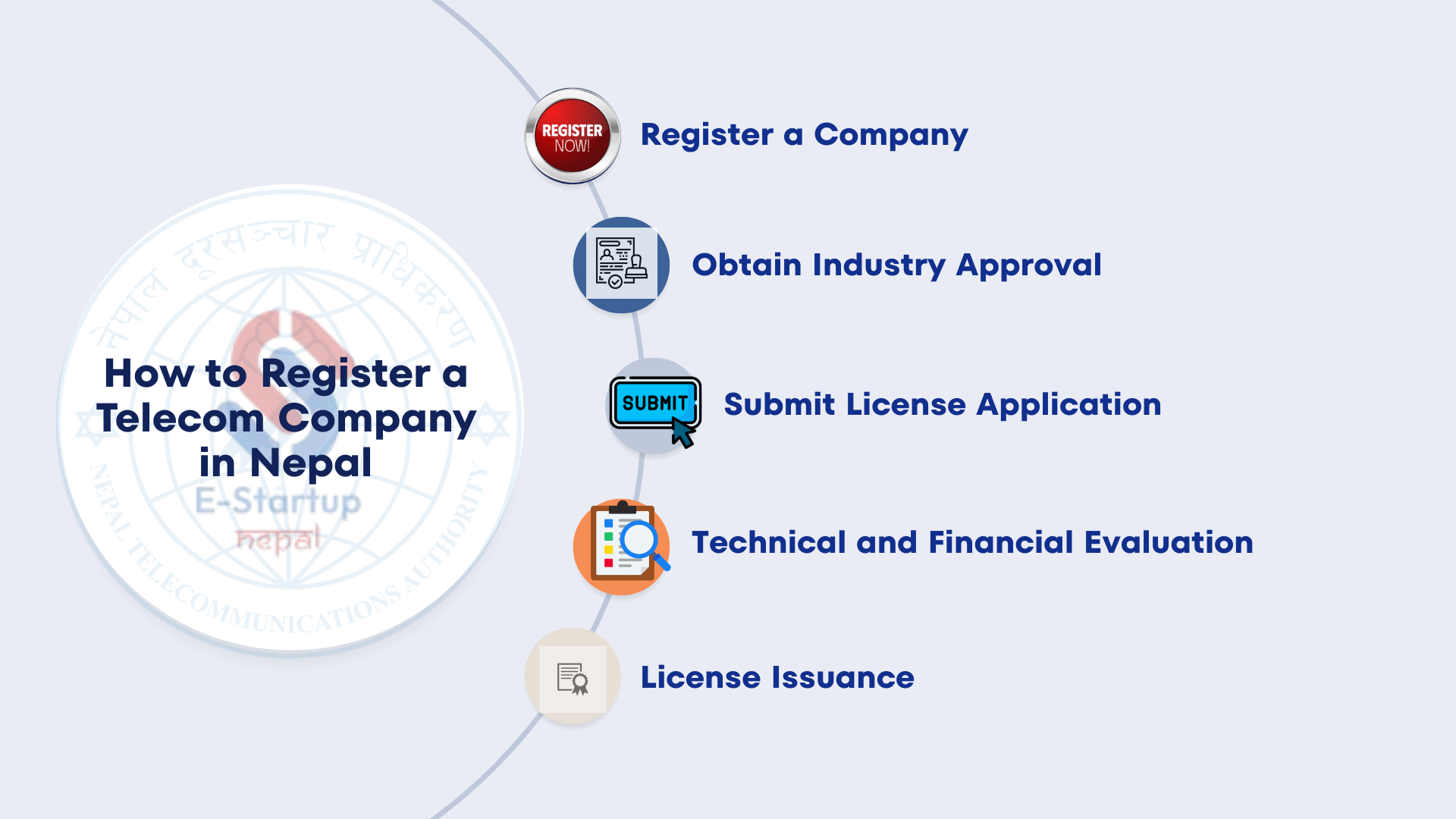
Starting a telecom company requires both company registration and sector-specific licensing.
Step 1: Register a Company
The business must first be incorporated under the Companies Act, 2063 through the Office of Company Registrar (OCR).
Required documents include:
Memorandum of Association
Articles of Association
Citizenship or passport copies of promoters
Registered office details
Shareholding structure
Step 2: Obtain Industry Approval
Depending on the nature of the service, investors may need approvals from:
Nepal Telecommunications Authority (NTA)
Ministry of Communication and Information Technology
Step 3: Submit License Application
The applicant must submit:
Business plan
Technical proposal
Network deployment plan
Financial projections
Corporate documents
Details of shareholders and directors
Step 4: Technical and Financial Evaluation
NTA evaluates:
Technical capability
Financial strength
Network infrastructure plan
Service quality commitments
Step 5: License Issuance
Upon successful evaluation and fulfillment of all requirements, NTA issues the telecom license.
Telecom License Categories in Nepal
Telecommunications Service Provider License
Allows operation of voice, mobile, and communication services.
Internet Service Provider (ISP) License
Permits provision of internet and broadband services.
Network Service Provider License
Authorizes construction and operation of telecommunications infrastructure.
Value-Added Service License
Applicable for services such as:
SMS platforms
Digital communication solutions
Cloud communication services
Security Deposit and License Fees for Telecom Companies in Nepal
One of the most important considerations for investors is the financial requirement associated with telecom licensing.
Application Fee
Applicants must pay a prescribed non-refundable application fee when submitting a license request to NTA.
Performance Bond or Bank Guarantee
Telecom operators are generally required to provide a performance guarantee or bank guarantee to ensure compliance with licensing conditions.
Security Deposit Requirements
The exact security deposit amount varies depending on:
Type of telecom service
License category
Service coverage area
Spectrum allocation requirements
Large-scale telecommunications operators may be required to deposit substantial guarantees running into millions of Nepalese Rupees.
License Renewal Fees
Telecom licenses are subject to periodic renewal and associated fees as prescribed by NTA.
Investment Opportunities in Nepal's Telecom Sector
Growing Demand for Digital Services
Nepal is witnessing increasing demand for:
High-speed internet
Cloud services
Digital payments
E-commerce
Online education
Expansion of Fiber Networks
Broadband infrastructure continues to expand throughout urban and rural regions.
Data Center and Cloud Opportunities
The growth of Nepal's digital economy creates opportunities for:
Data centers
Cloud services
Managed network solutions
Foreign Investment Potential
Foreign investors may participate in the telecom sector subject to:
Foreign Investment and Technology Transfer Act (FITTA), 2075
Sector-specific licensing requirements
Future of Telecommunications in Nepal
The Race Toward 5G
The next major development in Nepal's telecommunications industry is the introduction of 5G services.
Potential benefits include:
Ultra-fast internet speeds
Smart city infrastructure
Internet of Things (IoT)
Industrial automation
Advanced digital services
Digital Nepal Framework
Government initiatives under the Digital Nepal Framework are expected to further accelerate telecommunications infrastructure development.
Opportunities for New Entrants
Although the market is currently dominated by NTC and Ncell, emerging technologies may create opportunities for:
Specialized telecom services
Infrastructure providers
Digital communication platforms
Enterprise network solutions
Challenges for New Telecom Operators
New telecom companies face several barriers:
High capital requirements
Licensing obligations
Spectrum allocation costs
Infrastructure investment
Intense competition from established operators
As a result, entering the telecommunications market requires substantial financial and technical resources.
Conclusion
Nepal's telecom market remains largely controlled by Nepal Telecom and Ncell, making it one of the country's most established duopolies. Both operators continue to expand their 4G services while preparing for the eventual rollout of 5G technology.
For investors interested in entering the telecommunications sector, compliance with the Telecommunications Act, obtaining NTA approval, securing the required licenses, and meeting deposit and guarantee requirements are essential steps.
While the barriers to entry are significant, Nepal's growing digital economy continues to create opportunities in telecommunications, broadband, infrastructure development, and technology-driven communication services.
Frequently Asked Questions (FAQs)
Which authority regulates telecom companies in Nepal?
The Nepal Telecommunications Authority (NTA) regulates telecom operators and telecommunications services in Nepal.
Can foreign investors establish a telecom company in Nepal?
Yes, foreign investors can invest in telecom businesses subject to compliance with FITTA and sector-specific regulations.
Is an NTA license mandatory?
Yes. Any entity providing telecommunications services must obtain the appropriate license from NTA.
What security deposit is required for a telecom license?
The deposit amount varies depending on the license category and service scope. NTA determines the applicable financial guarantee requirements.
When is 5G expected in Nepal?
Pilot testing and preparatory activities have already been conducted, and broader commercial deployment is expected as infrastructure and spectrum policies evolve.